
Insights · Multilayer bags
Shielding, metalized or antistatic bag? Understanding ESD packaging terms
How ANSI/ESD S541 describes low-charging, dissipative and shielding packaging, and why a 'pink antistatic' bag is not a shielding bag.
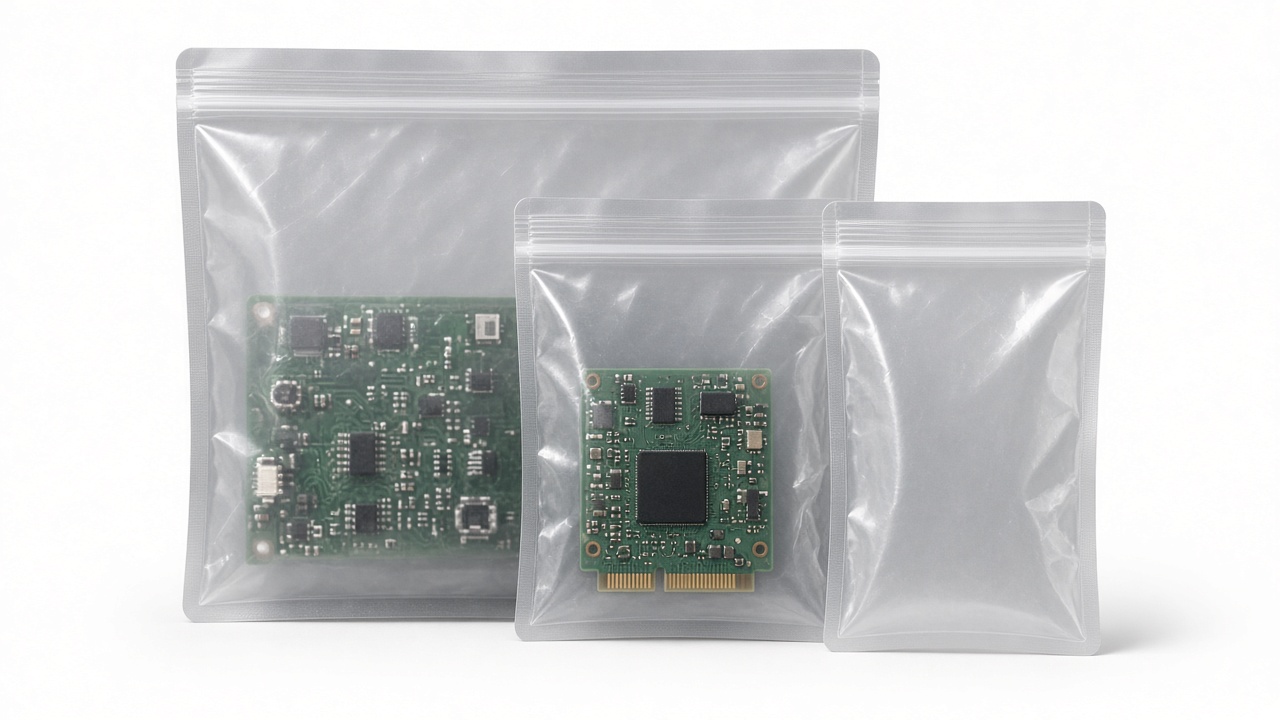
Product images are AI-generated illustrations or third-party photos showing generic product types – not Top Source goods or premises. Specifications are confirmed only in our quotation. See Image credits. (Created with Grok)
ESD packaging is described by a few material properties rather than by colour or trade names. The main US reference is ANSI/ESD S541, the ESD Association standard for packaging materials for ESD-susceptible items.[1][2]
Low-charging ("antistatic")
Polyethylene bags protect items from dust and handling but can accumulate static charge; antistat chemicals may be added to the film to make it low-charging, as the 2019 edition of S541 notes.[2] Low charging alone does not stop an external discharge from reaching the contents.
Dissipative and conductive
S541 groups packaging materials by their electrical resistance into conductive, dissipative and insulative ranges. Bag datasheets usually state the measured surface resistance of the inner and outer surfaces and the test method used.[4] Ask for these values rather than relying on the bag's colour.
Discharge shielding
A shielding bag attenuates an electrostatic discharge applied to the outside of the bag. According to ANSI's summary of the standard's revision history, the 2018 edition of S541 reduced the discharge-shielding specification from 50 nJ to 20 nJ; S541-2019 is a limited revision of that edition.[2] Datasheets typically report shielding energy measured to ANSI/ESD STM11.31.[4] S541 also states that transporting sensitive products outside an ESD-protected area requires packaging that provides low charge generation, dissipative or conductive material for intimate contact, and discharge shielding.[4]
Where do "metalized" bags fit?
"Metalized" or "metallised" is a supplier description of a film with a thin metal layer – it is not a class in S541. Shielding bags typically use a metal layer in a polyester / metal / polyethylene laminate ("metal-in" or "metal-out").[4][5] When a bag is offered as metalized, ask which properties it has been tested for (surface resistance, discharge shielding energy, and – if used for dry packing – WVTR) and against which standard.
Sources
- ESD Association – Standards (ANSI/ESD S541 and test methods)
- ANSI Blog – ANSI/ESD S541-2019: Standard for Packaging ESD Susceptible Items (archived copy: web.archive.org, 11 Mar 2026)
- Archived copy of the ANSI Blog article
- Example only, no affiliation – manufacturer's shielding-bag datasheet quoting S541 §6.2
- Example only, no affiliation – manufacturer's shielding-bag sales sheet (polyester / metal / polyethylene laminate)
Sources accessed 10 October 2026. Standards are summarised, not reproduced; consult the official edition.
Disclaimer: General information for reference only – not technical, engineering, legal or medical advice. Always follow the current official edition of the standards cited, your own risk assessment and the manufacturer's data.
More insights
- Choosing a moisture barrier bag for dry packing under J-STD-033
- How to select cleanroom gloves: class, cleanliness data and ESD
- Nitrile vs latex powder-free gloves for food handling and healthcare
- Chemical-resistant gloves: permeation, degradation and EN ISO 374
- Vietnam's semiconductor push: what the 2030 strategy says